

NRI Divorce Process in India: Complete Step-by-Step Guide (2026)

Yes, an NRI can file for divorce in India – and in most cases, it’s the safer route.
The real question isn’t whether you can file in India. It’s whether your case actually has Indian jurisdiction, and whether a decree from abroad will even hold up back home.
This guide walks through the full NRI divorce process: jurisdiction rules, whether you need to fly back, how foreign decrees are treated, and what happens if your spouse simply doesn’t respond.
Can an NRI File for Divorce in India?
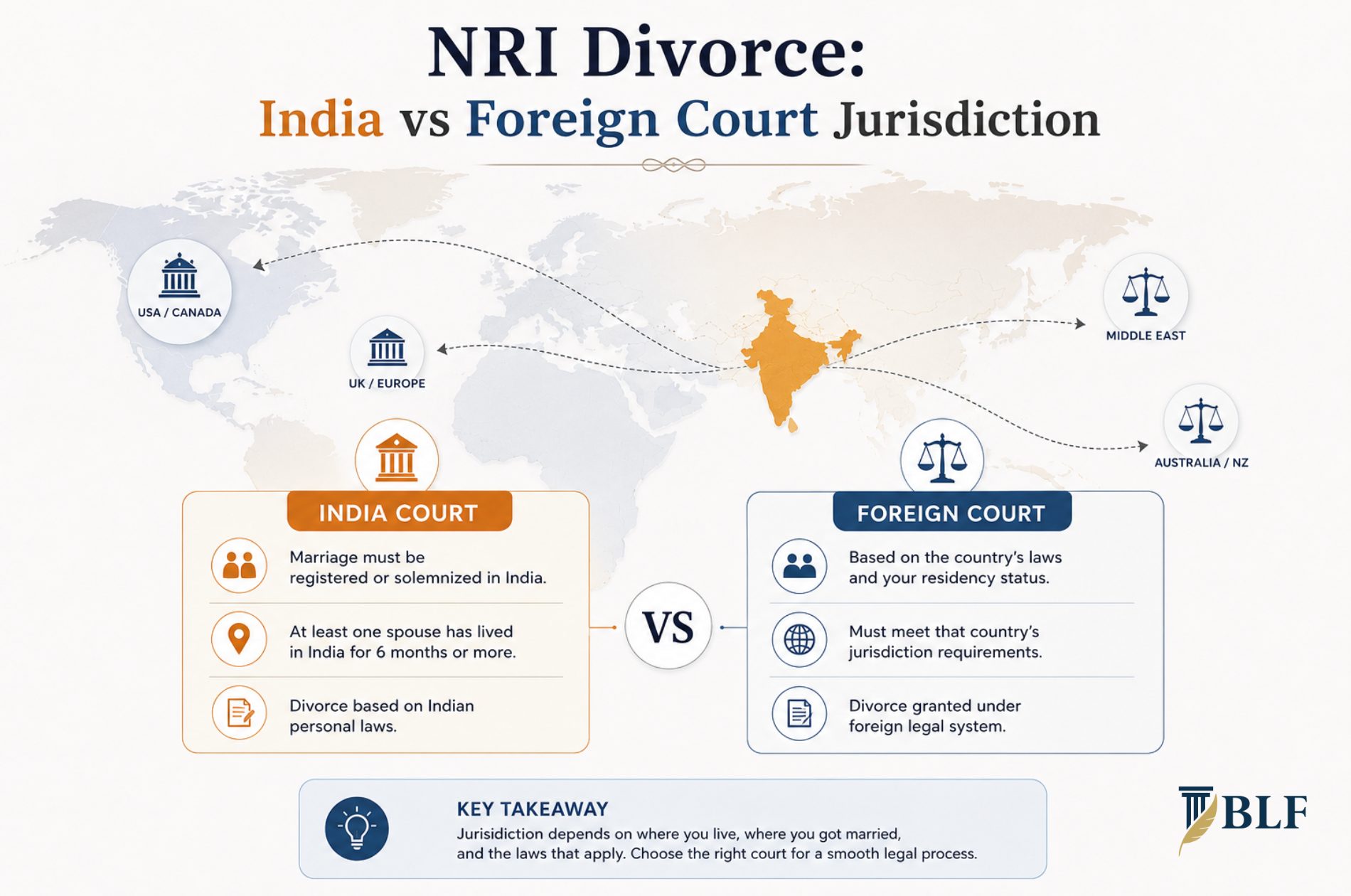
Yes – and Indian courts have clear rules for exactly which situations qualify.
Section 19 of the Hindu Marriage Act sets out where a divorce petition can be filed. It includes the place where the marriage was solemnized, where the couple last lived together, or where the wife is currently residing.
Importantly, it also covers the exact NRI scenario: if your spouse lives outside India, you can file in the Indian court where you currently reside.
So if you’re based in Delhi and your spouse has settled abroad, you don’t need their physical presence in India to start the case here.
Step-by-Step NRI Divorce Process in India
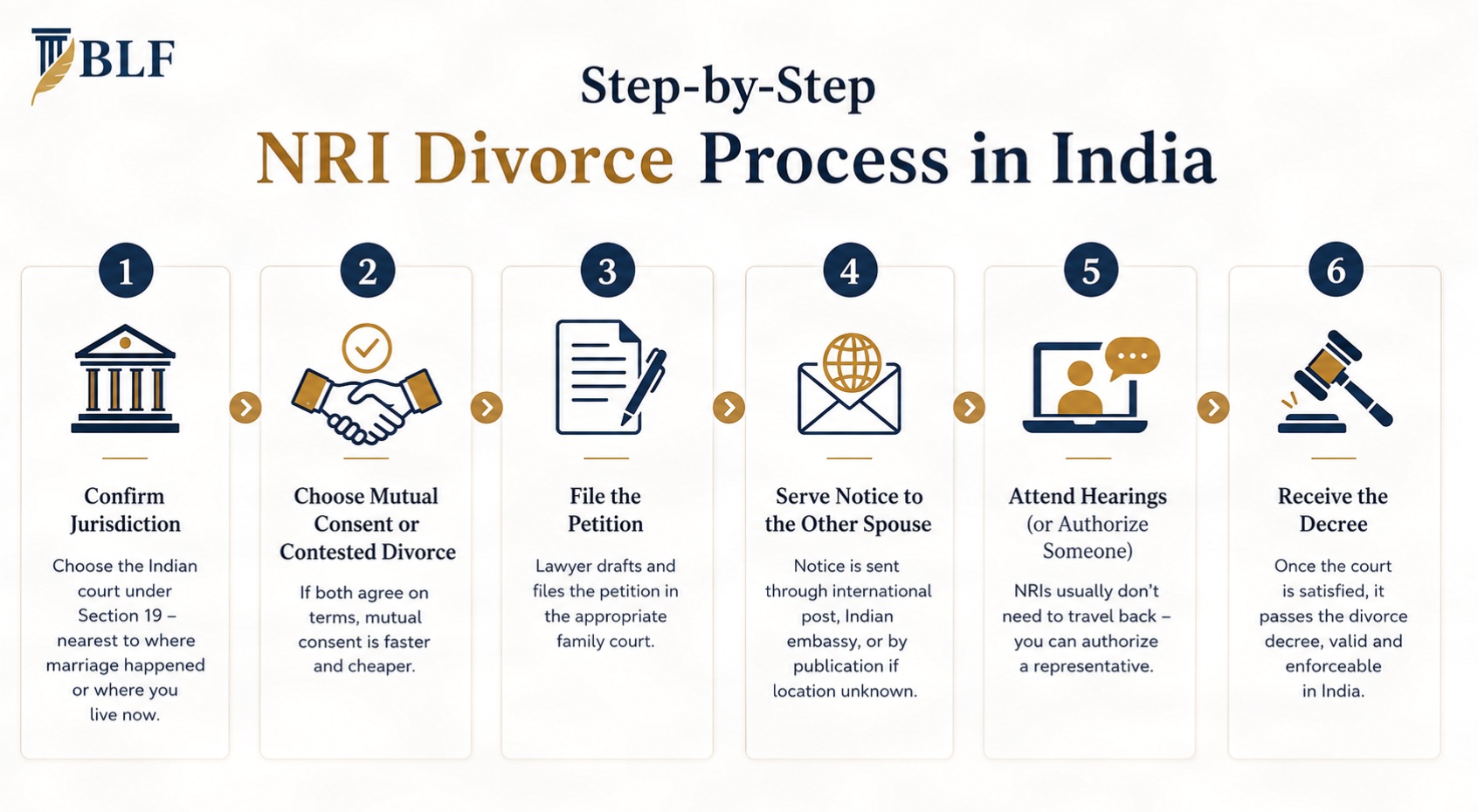
Here’s how the process actually unfolds.
1. Confirm jurisdiction. Decide which Indian court qualifies under Section 19 – usually the one nearest to where the marriage happened or where you live now.
2. Choose mutual consent or contested divorce. If both spouses agree on terms, mutual consent is faster and dramatically cheaper. Our mutual divorce process guide cover this route in detail.
3. File the petition. Your lawyer drafts and files the petition in the appropriate family court, listing grounds and settlement terms if it’s mutual consent.
4. Serve notice to the other spouse. If they’re abroad, notice is sent through registered international post, the Indian embassy in that country, or – if their location is unknown – by publication.
5. Attend hearings (or authorize someone to attend for you). This is where most NRIs assume they must fly back. They usually don’t have to – more on that below.
6. Receive the decree. Once the court is satisfied, it passes the divorce decree, which is valid and enforceable in India.
Do You Have to Be Physically Present in India?
Not necessarily.
For mutual consent divorce, courts have accepted a Power of Attorney (POA) holder appearing on the NRI spouse’s behalf for procedural hearings, once both spouses’ consent and settlement terms are clearly on record.
Any POA, affidavit, or supporting document signed abroad usually needs to be authenticated before Indian courts will accept it.
The Ministry of External Affairs confirms that Apostille certification – required for documents like Power of Attorney and affidavits used abroad – currently costs just ₹50 per document for countries under the Hague Convention.
This single step trips up more NRI cases than anything else. Skipping it is the easiest way to get your petition rejected on a technicality.
Mutual Consent vs Contested Divorce for NRIs
The choice matters even more when one spouse lives overseas.
A mutual consent divorce keeps travel, court visits, and legal costs to a minimum – both spouses settle alimony, custody, and property once, and the case moves quickly.
A contested divorce means multiple hearings, possibly across two countries’ time zones, and a much longer, costlier process. Read our full how to file divorce in Delhi comparison for what each route actually involves.
Is a Foreign Divorce Decree Valid in India?
Not automatically – and this catches a lot of NRIs off guard.
Section 13 of the Code of Civil Procedure, 1908 lists when a foreign judgment is not conclusive in India – including when the foreign court lacked proper jurisdiction, or when the judgment wasn’t decided on merits.
In the landmark case of Y. Narasimha Rao v. Y. Venkata Lakshmi, the Supreme Court held that a foreign divorce decree is only valid in India if the grounds for divorce match grounds recognized under Indian matrimonial law – and if the other spouse genuinely participated in or consented to those proceedings.
In plain terms: an ex-parte divorce obtained abroad, where your Indian spouse never appeared or consented, can be challenged and may not be recognized here.
This is exactly why so many NRI couples choose to file directly in India – it avoids this entire recognition battle later.
What Happens If Your NRI Spouse Doesn’t Respond?
This is more common than you’d think – and India’s courts have a process for it.
If the other spouse, whether in India or abroad, ignores court notices after being properly served, the court can proceed and grant an ex-parte divorce.
We cover exactly how this works, and what evidence the court expects, in our guide to ex-parte divorce in Delhi.
Documents Needed for NRI Divorce
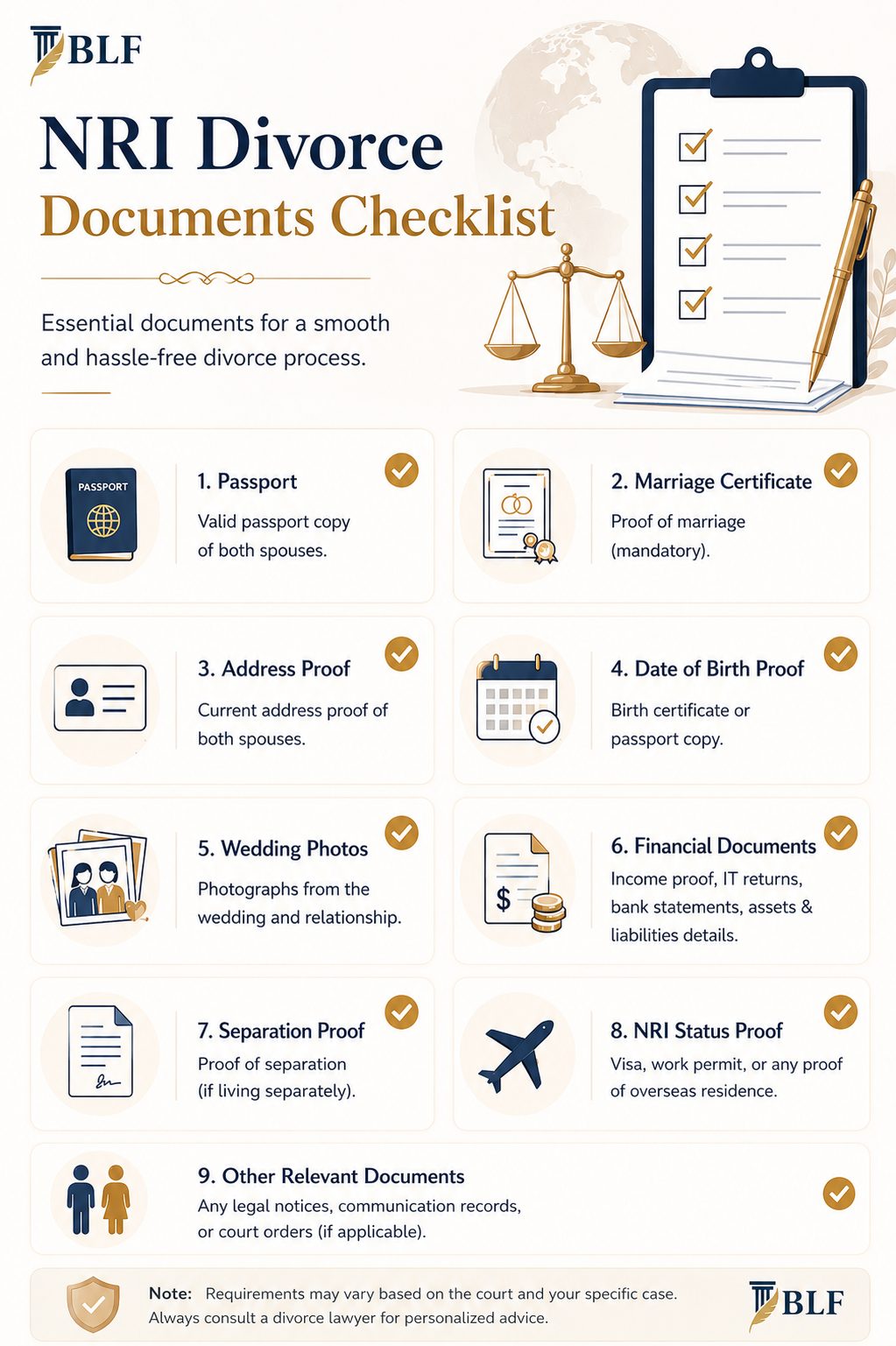
Most of these are the same as any Indian divorce, with one extra layer.
- Marriage certificate
- Passport and visa/residency proof for the NRI spouse
- Proof of address in India for the resident spouse
- Power of Attorney (apostilled, if signed abroad)
- Settlement terms covering alimony, custody, and property, if mutual consent
Our complete documents checklist for divorce in India lists exactly what to prepare – and preparing it correctly the first time avoids costly refiling.
Frequently Asked Questions
Often, yes – especially for mutual consent cases, where a Power of Attorney holder can represent the NRI spouse at procedural hearings once consent is clearly documented.
No. Under Section 13 of the CPC, it must meet specific conditions – including proper jurisdiction and grounds recognized under Indian law – to be enforced here.
Usually the court where the marriage took place, where the couple last lived together, or where the India-based spouse currently resides.
After proper service of notice, the court can move forward and grant an ex-parte divorce if the other party doesn’t respond.
Talk to a Lawyer Who Handles NRI Divorce Cases
Cross-border divorce comes with extra moving parts – jurisdiction, document authentication, and recognition issues that a standard divorce case doesn’t have.

Advocate Kamal Bhatla has guided NRI clients across Delhi NCR’s family courts through this exact process for over 21 years.
Book a free consultation or Call/WhatsApp +91-9899004529 to discuss your specific situation.
Disclaimer: This article is for general informational purposes and does not constitute legal advice. For guidance on your specific case, please consult Advocate Kamal Bhatla directly.

 +91 9899004529
