
How to File Divorce in Delhi: Step-by-Step Guide 2026

Most people searching “how to file divorce in Delhi” have already made the hardest decision. What they need now is a clear answer – not pages of legal theory.
So here it is: filing for divorce in Delhi follows a structured process that depends on two things – which law governs your marriage and whether your spouse agrees to the divorce.
Once you know both, the next steps become much easier to navigate.
Step 1 – Figure Out Which Law Applies to You
The first thing to determine is which statute governs your marriage. This decides everything – the grounds available to you, the procedure, and which court has jurisdiction.
Hindu Marriage Act, 1955 applies if both spouses are Hindu, Sikh, Buddhist, or Jain.
Special Marriage Act, 1954 applies to civil marriages and inter-faith marriages registered under this Act.
Muslim Personal Law governs divorce for Muslim couples, with different procedures for talaq, khula, and mutual divorce.
Christian couples file under the Indian Divorce Act, 1869.
The rest of this guide focuses on the Hindu Marriage Act and Special Marriage Act, which cover the majority of divorce cases filed in Delhi’s family courts.

Step 2 – Decide Which Type of Divorce Applies
There are two broad routes. Choosing the right one at the start saves a lot of time.
Mutual Consent Divorce
This is the simpler, faster route. Both spouses agree to end the marriage and have sorted out – or are willing to negotiate – the terms around alimony, child custody, and property. If both parties are on the same page, mutual consent divorce is almost always the recommended path.
The only legal requirement before filing is that the couple must have lived separately for at least one year.
Contested Divorce
This applies when one spouse wants the divorce and the other does not, or when there are serious unresolved disputes.
It takes longer and requires proving specific legal grounds before the court. If your spouse is refusing to cooperate, read this first: how to file for divorce when your spouse refuses.
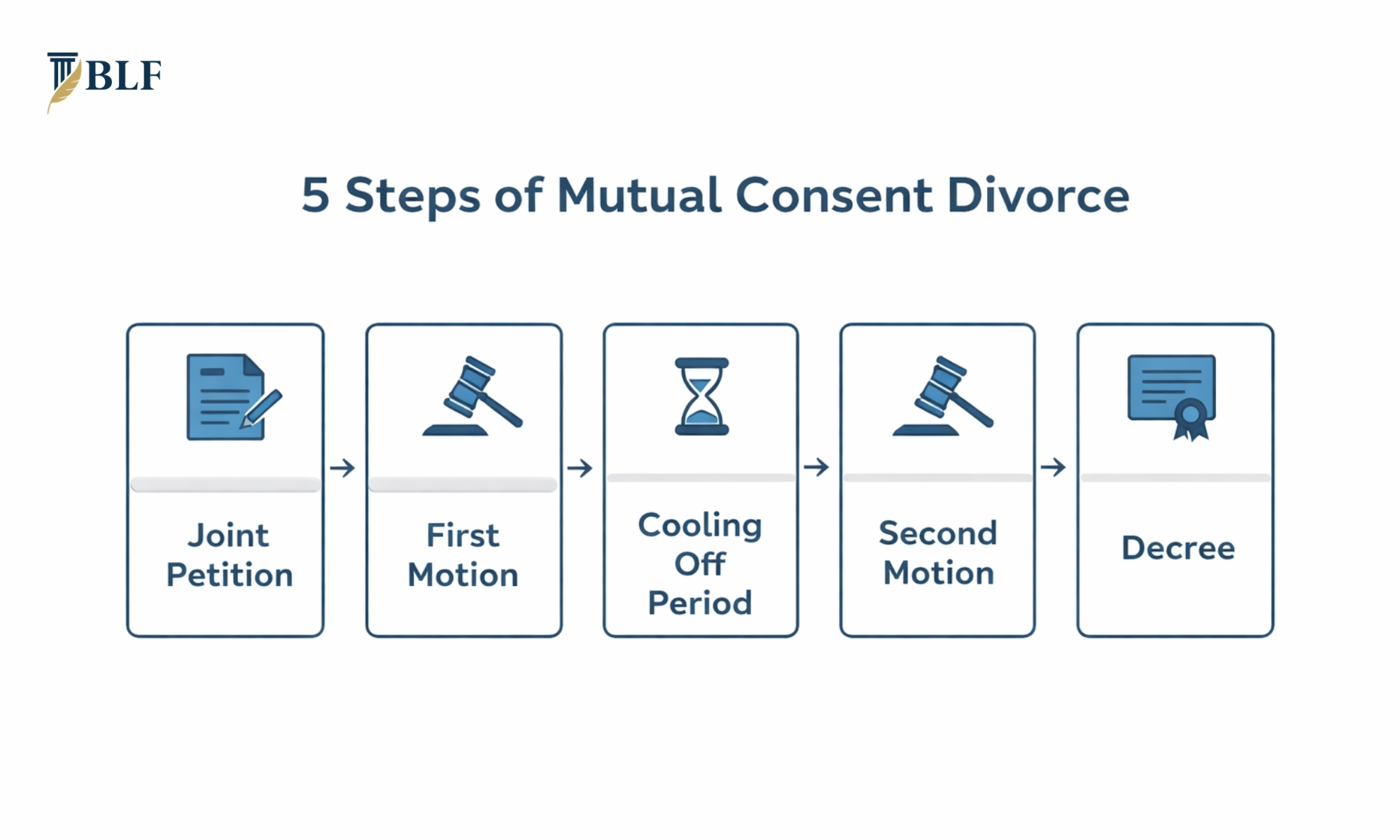
Step 3 – The Mutual Consent Divorce Process
Here is how a mutual consent divorce actually works in Delhi’s family courts:
1. Draft the joint petition Both spouses sign a joint petition stating that they have been living separately for at least one year, that they have been unable to reconcile, and that they mutually agree to dissolve the marriage. The petition also covers agreed terms on alimony and custody.
2. File the petition: The petition is filed at the relevant family court – either Tis Hazari, Karkardooma, Rohini, or Saket, depending on where either spouse currently resides. See the complete guide to Delhi NCR matrimonial courts if you are unsure which court applies to you.
3. First motion hearing Both spouses appear before the court. Statements are recorded. The court admits the petition and schedules the second motion hearing.
4. Cooling-off period A mandatory 6-month waiting period follows the first motion. This is built into the law to allow for possible reconciliation.
Courts can waive this period if they are satisfied that the marriage has irretrievably broken down and waiting serves no purpose.
5. Second motion hearing Both spouses appear again. If both still wish to proceed, the court passes the divorce decree. The marriage is legally dissolved from this date.
Typical timeline: 6 to 18 months depending on how quickly the court schedules hearings and whether the cooling-off period is waived.

Step 4 – The Contested Divorce Process
Divorce without mutual consent follows a different path and requires considerably more preparation.
1. Establish legal grounds You must file on one of the recognised grounds under the Hindu Marriage Act – cruelty, adultery, desertion for two or more continuous years, mental illness, or conversion. Cruelty is the most commonly cited ground in Delhi family courts and covers both physical and mental harassment.
2. File the petition Your advocate drafts and files the divorce petition at the appropriate family court. The petition must clearly state the grounds and supporting facts.
3. Notice to the other spouse The court issues a notice to your spouse, who then has the right to file a reply contesting the petition.
4. Mediation attempt Delhi family courts typically direct both parties to attempt mediation before the matter proceeds to full trial. This is standard practice and not optional in most cases.
5. Trial If mediation fails, the matter proceeds to trial. Both sides present evidence, documents, and witnesses. The judge examines everything before delivering a verdict.
6. Decree If the court is satisfied, a divorce decree is passed. Either party can appeal within the prescribed period.
Typical timeline: 2 to 5 years in contested cases, depending on complexity and court scheduling.

Step 5 – Documents You Will Need
Whether you are filing a mutual or contested divorce, certain documents are required at the time of filing. The complete checklist is covered in detail here: documents required for divorce in India.
The core set includes:
- Marriage certificate
- Address proof of both spouses (for establishing court jurisdiction)
- Passport-size photographs
- Evidence of separation – rent agreements, utility bills, or other proof showing separate residence
- Income and asset documents (relevant for alimony and maintenance claims)
- Any prior legal correspondence between spouses
In contested cases, you will also need evidence supporting your specific ground – medical records for cruelty cases, financial records for maintenance disputes, and so on.
What About Alimony and Child Custody?
These are often the most contentious parts of any divorce proceeding and are worth thinking through separately from the divorce petition itself.
Alimony – also called spousal maintenance – is not automatic. It depends on factors like income, assets, duration of the marriage, and standard of living. Learn more about how alimony works in Delhi.
Child custody is decided based on the best interests of the child. Delhi courts look at the child’s age, existing bonds, living conditions, and the capacity of each parent to provide care. Read about child custody rights in Delhi.
Both matters can be settled as part of a mutual consent agreement or decided by the court in contested proceedings.
Free Legal Aid in Delhi
If engaging a private advocate is not financially feasible, free legal aid is available. The National Legal Services Authority (NALSA) provides free legal representation and mediation services to eligible individuals across India.
The Delhi State Legal Services Authority (DSLSA) handles cases at the state level and can be approached directly at Tis Hazari Courts.
Frequently Asked Questions
Can I file for divorce in Delhi if my marriage took place in another state?
Yes. You can file at the family court within whose jurisdiction either you or your spouse currently resides. The place of marriage is not a constraint under the Hindu Marriage Act.
Can the 6-month cooling-off period in mutual consent divorce be skipped?
Courts have the discretion to waive it. In practice, this is more likely if both spouses are firm, no children are involved, and the separation has already been long.
What if my spouse does not appear in court after being served notice?
If your spouse fails to appear despite proper notice, the court can proceed ex-parte – meaning it continues without their participation. Bhatla Law Firm handles ex-parte divorce cases in Delhi specifically.
Can I file for divorce immediately after marriage?
Generally, you must wait one year from the date of marriage. Exceptions exist in cases of exceptional hardship or cruelty. Read about filing divorce immediately after marriage.
Is it possible to cancel a divorce after it is granted?
In limited circumstances, yes – but only before the decree becomes absolute. Once absolute, reversal is not possible through the same proceedings.
Getting Legal Help for Divorce in Delhi
Filing for divorce involves paperwork, court appearances, negotiations, and – in contested cases – active litigation. Having an advocate who knows Delhi’s family courts well makes a significant difference to both the timeline and the outcome.
Bhatla Law Firm handles all categories of divorce cases across Delhi – mutual consent divorce, contested divorce, ex-parte proceedings, alimony, and child custody.
The firm is led by Advocate Kamal Bhatla, who has represented clients across Dwarka, Tis Hazari, Karkardooma, Rohini, Saket & Patiala House courts.
Contact Details:
Office Address : Chamber No. 442, Patiala House Courts Complex, Patiala House, India Gate, New Delhi, Delhi 110001 (View of Google Maps)
Other Chambers:
- 581, 3rd Floor, Gali No. 21, Shiv Nagar, Janakpuri
- CH 841, Dwarka Courts Complex
- Ch B/342, Gurugram District Court
Phone or Whatsapp: 91-9899004529
Email : info@bhatlalawfirm.com
Disclaimer: This article is for informational purposes only and does not constitute legal advice. Please consult a qualified family law advocate for advice specific to your situation.

 +91 9899004529
