

Can a Working Wife Claim Maintenance in India – 2026 Guide

Yes, a working wife can claim maintenance in India – and courts have repeatedly upheld this right.
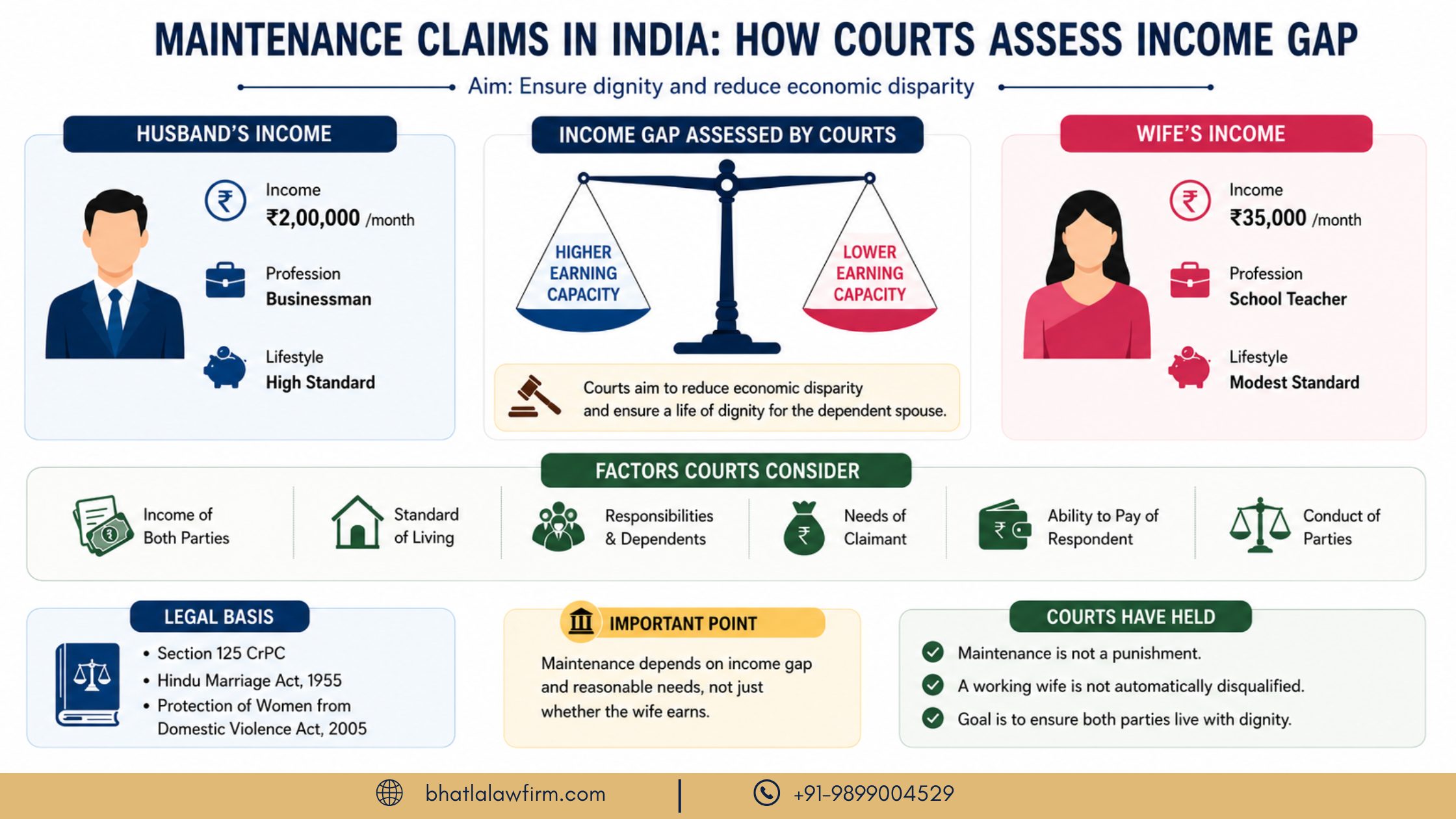
Having a salary does not automatically disqualify you. What matters is whether your income is sufficient to maintain the standard of living you had in your matrimonial home.
If there is a significant gap between your earnings and your husband’s, you have a strong legal basis to seek maintenance.
The Short Answer Courts Have Given
The Supreme Court in Shailja v. Khobbanna (2018) made this crystal clear: merely because a wife is capable of earning is not sufficient ground to deny or reduce maintenance.[1]
The test is not whether she earns. The test is whether she can maintain herself at the lifestyle she enjoyed during the marriage.
This principle has been consistently followed in courts across India.
What Law Governs Maintenance Claims?
Indian law provides multiple routes for a wife to claim maintenance:
- Section 144 of BNSS (formerly Section 125 CrPC) – applicable to all women regardless of religion
- Section 24 of the Hindu Marriage Act, 1955 – interim maintenance during divorce proceedings
- Section 25 of the Hindu Marriage Act, 1955 – permanent alimony after divorce
- Section 20 of the Domestic Violence Act, 2005 – monetary relief including maintenance
Each law has slightly different conditions. A qualified divorce lawyer can advise which route gives you the strongest claim.
Disclaimer: This article is for general information only and does not constitute legal advice. Please consult a qualified advocate for advice specific to your situation.
How Does a Working Wife’s Income Impact Maintenance?
Courts consider both spouses’ incomes together – not in isolation.
In Kiran Jyot Maini v. Anish Pramod Patel (2024), the Supreme Court laid down that courts must assess: the status and lifestyle of the parties, the wife’s reasonable needs, her qualifications and employment history, and whether her income is sufficient for self-maintenance.[2]
Bottom line: If your husband earns significantly more than you, courts will usually bridge the gap.
Can a Working Wife Claim Maintenance Without Divorce?
Yes. A wife does not need to file for divorce to claim maintenance.
Under Section 144 of BNSS, a wife living separately from her husband – for valid reasons such as cruelty, desertion, or neglect – can file for maintenance before a First-Class Magistrate.[3]
This is one of the most practical options for women who want financial support while deciding whether to pursue a divorce.
Learn more about your options in a contested divorce situation.
Can a Working Wife Claim Maintenance After Divorce?
Yes, she can – under Section 25 of the Hindu Marriage Act and Section 144 BNSS.[4]
The court will evaluate her post-divorce financial position. If she cannot sustain herself at a reasonable standard, the court can award ongoing maintenance or a one-time alimony.
For alimony and spousal maintenance matters in Delhi courts, Bhatla Law Firm has successfully secured significant maintenance awards for wives in Family Courts across Delhi NCR.
Can a Working Wife Claim Maintenance for a Child?
Absolutely. Child maintenance is treated separately and is a non-negotiable parental duty.
Even if the court reduces or denies spousal maintenance because the wife is financially capable, child maintenance cannot be waived. Courts assess the child’s needs for education, health, and daily living independently.
The Supreme Court reinforced this in Rajnesh v. Neha (2021) 2 SCC 324, which issued mandatory guidelines making it clear that a child’s maintenance is assessed independently from the mother’s income or any waiver in a settlement agreement.[5]
No settlement agreement can legally extinguish a child’s right to maintenance.
When Can Maintenance Be Denied to an Earning Wife?
Courts are not blanket in granting maintenance. There are situations where claims are denied:
- The wife is highly educated, professionally qualified, and has a well-paying job comparable to her husband’s.
- She voluntarily refuses to work despite having the capacity.
- She is fully self-sufficient with independent income or assets.
In Shikha v. Avaneesh Mahodaya (10 September 2024), the Madhya Pradesh High Court reduced maintenance for a well-educated wife with a Master’s degree and prior work experience, holding that Section 125 CrPC is meant for those genuinely unable to support themselves – not for those who choose not to work.[6]
The key distinction courts draw: capability to earn vs. actual sufficiency of earnings.
Can a Wife Claim Maintenance After Mutual Divorce?
This depends entirely on how the settlement agreement was drafted.
If the mutual divorce agreement clearly states the wife accepts a one-time payment as full and final settlement and waives future claims, courts generally uphold that.
However, if the agreement is silent on future maintenance, or if it was poorly worded, the wife may still file under Section 25 HMA or Section 144 BNSS.
In Sheela George v. V.M. Alexander (2025:KER:37581), the Kerala High Court allowed a divorced wife’s maintenance claim even after a prior settlement, noting that the right to maintenance under Section 37 of the Indian Divorce Act is not absolutely extinguishable by a one-time payment.[7]
Lesson: Settlement agreements must be carefully drafted. Both sides should have experienced legal counsel. Reach out to Bhatla Law Firm to ensure your agreement protects your interests.
Can a Wife Claim Maintenance After Remarriage?
No. Personal maintenance from the ex-husband stops upon the wife’s remarriage.
Once she remarries, her former husband is legally absolved of the obligation to support her. This applies across all personal laws.
However, child maintenance is unaffected by remarriage. The biological father’s duty to support the child continues regardless of either parent’s remarriage.
Can a Second Wife Claim Maintenance Under Section 125 CrPC / BNSS?
This is a nuanced area of law.
Strictly speaking, a second wife during the subsistence of a valid first marriage is not a “legally wedded wife” and may not qualify under Section 144 BNSS.
But courts have created important exceptions:
- If the husband concealed his first marriage from the second wife, courts have granted her maintenance – as held in Badshah v. Urmila Badshah Godse (2014) 1 SCC 188[8]
- In X v. State of Maharashtra (2023:BHC-AS:37561), the Bombay High Court upheld maintenance to a second wife when evidence supported the marital relationship and the husband could not use his own deception as a defense.[9]
In Smt. N. Usha Rani v. Moodudula Srinivas (2025 INSC 129), the Supreme Court held that a woman separated from her first husband – even without a formal divorce decree – can claim maintenance from her second husband, provided she had disclosed her situation honestly and the second husband knowingly entered the marriage.[10]
Can a Woman in a Live-In Relationship Claim Maintenance?
Yes, under the Protection of Women from Domestic Violence Act, 2005.
Courts have recognised that women in long-term live-in relationships deserve protection. In Chanmuniya v. Virendra Kumar Singh Kushwaha (2011), the Supreme Court held that strict proof of marriage should not be a pre-condition for maintenance when a man and woman have lived together for a reasonably long period.
The DV Act provides maintenance as a form of monetary relief for women in “relationships in the nature of marriage.”
Can a Wife Claim Maintenance in a Restitution of Conjugal Rights Case?
Yes. A restitution of conjugal rights (RCR) decree does not stop a wife from claiming maintenance.
The Supreme Court held in Rina Kumari v. Dinesh Kumar Mahto that if the wife has valid reasons to live separately – such as cruelty, dowry demands, or lack of basic amenities – a RCR decree does not absolve the husband from paying maintenance under Section 144 BNSS.
Documents Required for a Working Wife to Claim Maintenance
When filing a maintenance petition, you will typically need:
- Marriage certificate
- Proof of residence and separation
- Your salary slips or income proof (last 3–6 months)
- Husband’s salary slips, ITR, or evidence of income/assets
- Children’s birth certificates (if claiming child maintenance)
- Any evidence of cruelty, neglect, or desertion
- Bank statements
Courts now routinely require a Financial Affidavit from both parties to ensure full income disclosure.
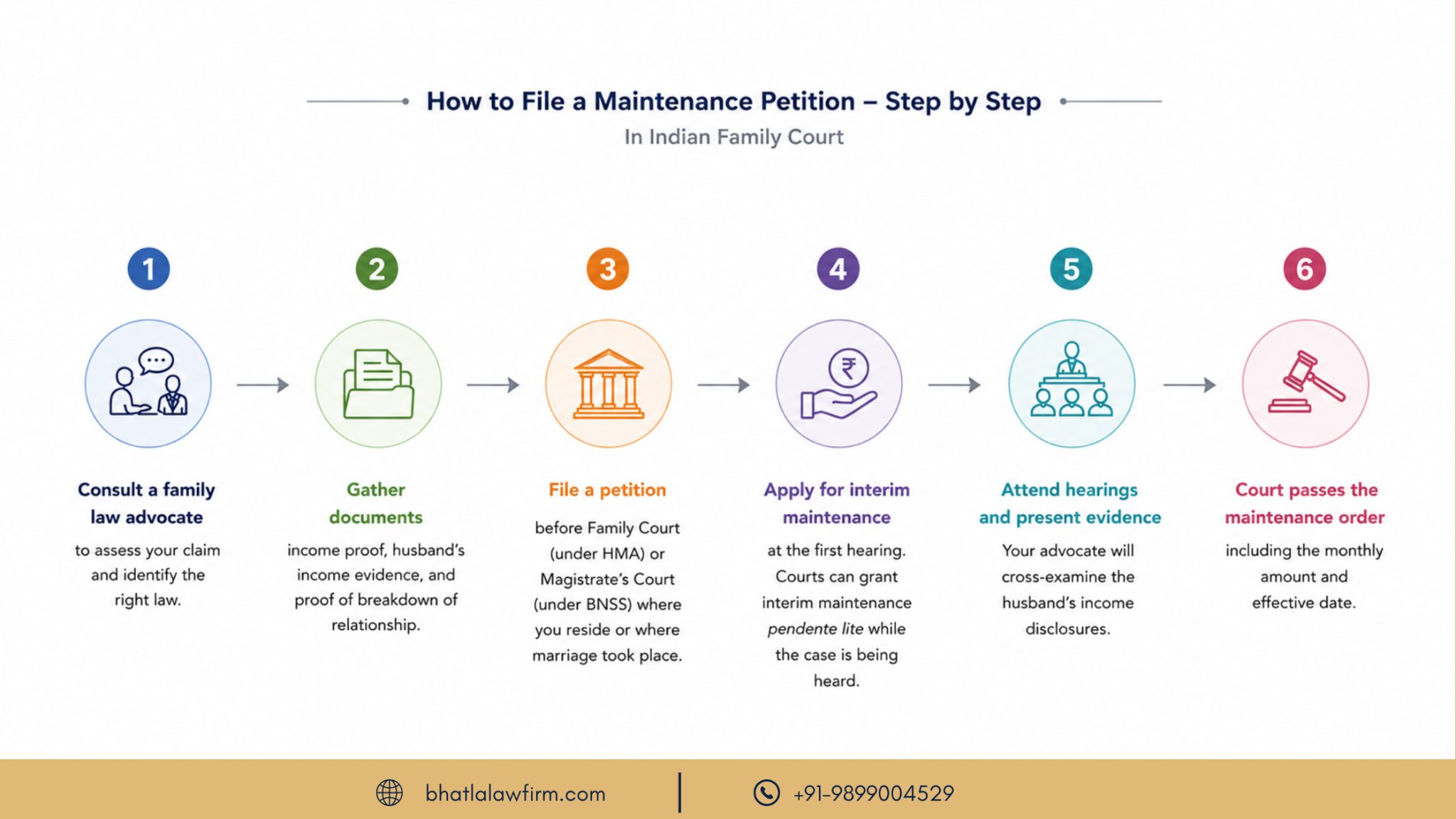
How to File a Maintenance Petition – Step by Step
Step 1: Consult a family law advocate to assess your claim and identify the right law to file under.
Step 2: Gather documents – your income proof, husband’s income evidence, and proof of the breakdown of the matrimonial relationship.
Step 3: File a petition before the Family Court (under HMA) or the Magistrate’s Court (under BNSS) in the jurisdiction where you reside or where the marriage took place.
Step 4: Apply for interim maintenance at the first hearing itself. Courts can grant interim maintenance pendente lite while the case is being heard.
Step 5: Attend hearings and present evidence. Your advocate will cross-examine the husband’s income disclosures.
Step 6: Court passes the maintenance order – including the monthly amount and effective date.
Latest Supreme Court Position – Working Wife and Maintenance
The current judicial trend is balanced but pro-woman in cases of income disparity.
Courts are not denying maintenance simply because the wife works. They are comparing relative incomes, lifestyle during marriage, and actual financial sufficiency.
The Bombay High Court’s 2025 ruling – relying on the Supreme Court’s framework in Rajnesh v. Neha (2021) and Kiran Jyot Maini (2024) – confirmed that a working wife earning less than her husband is entitled to maintenance bridging the gap.
The exceptions remain: a highly qualified, well-employed wife earning at par with her husband is unlikely to succeed in a maintenance claim purely on spousal grounds.
Need Help? Talk to a Maintenance Lawyer in Delhi
Every maintenance case turns on its specific facts – your income, your husband’s income, your lifestyle, and how the relationship broke down.
At Bhatla Law Firm, Advocate Kamal Bhatla has over 21 years of experience handling maintenance and alimony cases across Delhi Family Courts, Saket Court, Dwarka Court, and Patiala House Courts Complex.
Whether you are seeking maintenance or defending against an inflated claim, we provide clear, strategic, and confidential legal guidance.
📞 Call/WhatsApp: +91-9899004529
📍 Address: Chamber No. 442, Patiala House Courts Complex, New Delhi – 110001
Frequently Asked Questions
Can a working wife claim maintenance if she earns a salary?
Yes. The court looks at whether her salary is sufficient to maintain the standard of living she had during marriage, not just whether she earns.
What is the maximum maintenance a working wife can get?
There is no fixed cap. Courts consider both spouses’ income, assets, lifestyle, and needs. The amount is discretionary.
Can a working wife claim maintenance without filing for divorce?
Yes. Under Section 144 BNSS, she can file before a Magistrate while still married, if living separately for valid reasons.
Does a one-time settlement bar future maintenance claims?
Generally yes, if the agreement is clearly worded and accepted as full and final. Poorly drafted agreements can be challenged.
Can a wife claim maintenance after mutual divorce in India?
Only if the mutual divorce settlement did not include a full and final alimony waiver, or if child maintenance is separately at issue.
References:
- https://indiankanoon.org/doc/176136151/ ↩︎
- https://indiankanoon.org/doc/12543220/ ↩︎
- https://indiankanoon.org/doc/99662587/ ↩︎
- https://indiankanoon.org/doc/95286/ ↩︎
- https://indiankanoon.org/doc/117541087/ ↩︎
- https://indiankanoon.org/doc/66886093/ ↩︎
- https://indiankanoon.org/doc/184012680/ ↩︎
- https://indiankanoon.org/doc/15901386/ ↩︎
- https://bombayhighcourt.nic.in/ ↩︎
- https://indiankanoon.org/doc/56187356/ ↩︎

 +91 9899004529
