

498A Case Filed Against You? Here’s What to Do Next (2026)

Getting a 498A notice or FIR feels like the ground has shifted beneath you.
Your first instinct might be to panic, or to try to “sort it out” by calling your wife or her family. Both of these are mistakes.
This guide tells you exactly what to do in the first 72 hours and beyond, what your legal rights are, and how courts in India are increasingly recognizing misuse of this provision.
What Is a 498A Case? (And What Changed in 2026)
Section 498A of the Indian Penal Code made cruelty by a husband or his relatives towards a married woman a criminal offence. It was introduced in 1983 to protect women from dowry-related harassment and domestic violence.
Here is the critical 2026 update: Section 498A no longer exists as that number.
From 1 July 2024, the Indian Penal Code was replaced by the Bharatiya Nyaya Sanhita (BNS). Section 85 of the BNS now carries the same offence forward with identical language and the same punishment of up to three years imprisonment and fine.
If your FIR was registered before 1 July 2024, it continues under the old IPC Section 498A. If it was filed after, it is under Section 85 BNS. The legal provisions, defences, and bail process remain the same.
People still call it a “498A case” in everyday language, and this post uses that term throughout.
The 3 Most Important Facts You Need to Know Right Now
1. Arrest is not automatic.
This is the single biggest misconception. Because 498A is a cognizable and non-bailable offence, many people assume the police can arrest you the moment an FIR is registered.
The Supreme Court shut this down in Arnesh Kumar v. State of Bihar (2014). The Court held that police cannot arrest a person in a 498A case without first going through a checklist under Section 41 CrPC and recording written reasons justifying the arrest. Magistrates must independently verify those reasons before authorizing any detention.
Police officers who arrest without following this process can be held in contempt. Delhi High Court has actually sentenced a police officer to one day in jail for violating these guidelines.
2. The offence is non-bailable, not non-grantable.
Non-bailable means you cannot demand bail as a right at the police station. It does not mean bail is impossible. You can apply for regular bail before a Magistrate, or apply for anticipatory bail before the Sessions Court or High Court if you fear arrest.
3. Courts are taking misuse seriously.
In Arnesh Kumar v. State of Bihar, the Supreme Court noted that in 2012, charge-sheeting rates in 498A cases were 93.6% but conviction rates were just 15%. The Court explicitly stated that Section 498A was being used as a weapon rather than a shield in many cases.
Courts today look carefully at the specificity of allegations, the timing of the complaint, and whether the same allegations appear across multiple relatives without individual detail.
7 Steps to Take Immediately After a 498A Case Is Filed
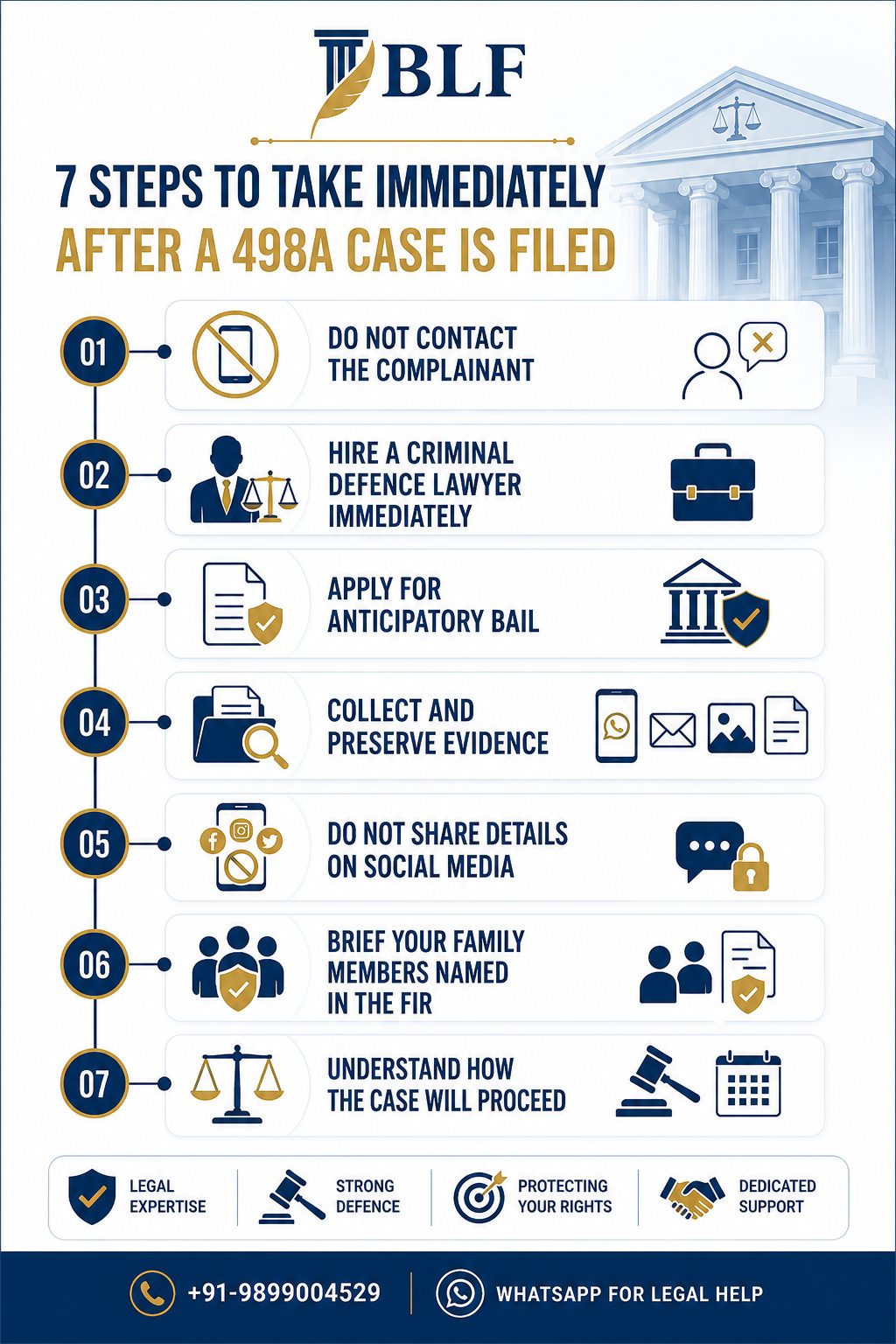
Step 1: Do Not Contact the Complainant
This is the rule that protects you the most and that people most often break.
Calling your wife, her parents, or anyone connected to the complaint, even to explain yourself, can be treated as intimidation or tampering with the complainant. It will hurt you in court and in bail proceedings.
Cut off all direct contact from the moment you learn about the FIR.
Step 2: Hire a Criminal Defence Lawyer Immediately
Do not wait to “see what happens.” A 498A case moves fast once an FIR is filed.
You need a lawyer who can appear before the Magistrate or Sessions Court to argue bail, challenge the allegations, and push back on any arrest attempt that does not follow the Arnesh Kumar guidelines.
At Bhatla Law Firm, Advocate Kamal Bhatla has over 21 years of experience handling 498A cases across Delhi NCR’s courts. Call or WhatsApp: +91-9899004529.
Step 3: Apply for Anticipatory Bail
If the FIR has been filed but you have not yet been arrested, apply for anticipatory bail immediately.
Anticipatory bail is filed before the Sessions Court or High Court. If granted, it protects you from arrest for the duration specified by the court.
Do not delay this step. A bail application filed before a possible arrest is significantly stronger than one filed from custody.
Step 4: Collect and Preserve Evidence
Start gathering evidence that disproves or contextualizes the allegations. This includes:
- WhatsApp messages, emails, and call records showing the nature of your communication
- Bank statements that disprove claims of not providing financial support
- Photographs, videos, or witnesses that establish the actual domestic environment
- Documents showing joint travel, family events, or shared decisions that contradict the narrative of cruelty
- Evidence of any matrimonial disputes, property fights, or divorce discussions that predate the complaint
Evidence gaps are very hard to fill later. Do this on day one.
Step 5: Do Not Share Details on Social Media
A 498A case, whether genuine or false, involves your marriage, family, and personal life.
Posting about the FIR, your situation, or your wife’s conduct online creates a public record that prosecutors and opposing counsel will use against you. It can also complicate bail hearings. Stay silent publicly.
Step 6: Brief Your Family Members Named in the FIR
498A complaints frequently name the husband’s parents, siblings, and sometimes even relatives who live in different cities or countries.
Each named person must be briefed by your lawyer separately. They may need their own anticipatory bail applications if they are named as accused. The Arnesh Kumar guidelines protect all of them equally, but they need to act quickly.
Step 7: Understand How the Case Will Proceed
A 498A case follows a criminal trial process: FIR, charge sheet, framing of charges, evidence, cross-examination, arguments, and verdict. This takes years.
Your divorce case, if one is filed, runs separately from the criminal case. The two proceedings run simultaneously and can affect each other, especially on questions of maintenance and custody.
Our guide to how long divorce takes in India covers the civil side. For the criminal side, your lawyer needs to manage both tracks together.

Can a 498A Case Be Quashed?
Yes, and this is a real option in many cases.
If the allegations are vague, do not specify individual acts, or are clearly filed as part of a matrimonial dispute after divorce proceedings began, your lawyer can file a petition under Section 528 of the BNSS (earlier Section 482 of CrPC) before the High Court seeking quashing of the FIR.
Courts have quashed 498A FIRs in cases where:
- Allegations against relatives are identical and lack any individual specificity
- The complaint is filed months or years after the alleged acts, with no explanation for the delay
- The FIR is filed only after the wife receives a divorce notice or is denied custody
- A genuine settlement between the parties has been reached
The Supreme Court in Kahkashan Kausar v. State of Bihar (2022) specifically cautioned courts against allowing omnibus and vague allegations against relatives to proceed without scrutiny.
Quashing, if successful, ends the criminal case entirely.
Can a 498A Case Be Settled?
The offence is non-compoundable, meaning the wife cannot simply withdraw the complaint on her own once it is registered.
However, settlements are still possible through two routes.
Route 1: Mutual divorce with quashing petition. If both spouses agree to divorce and settle all claims, a joint petition for quashing can be filed before the High Court alongside the settlement. Courts regularly allow this. Our mutual divorce process guide covers the parallel civil process.
Route 2: Mediation under court supervision. Some courts refer 498A matters to mediation, especially where the dispute is fundamentally matrimonial rather than criminal. If mediation succeeds and a comprehensive settlement is reached, a quashing petition follows.
Settlement does not mean guilt. It means both parties chose resolution over prolonged litigation.
Frequently Asked Questions
No. Under the Arnesh Kumar guidelines, police must follow a checklist, record written reasons, and get Magistrate approval before arresting someone in a 498A or Section 85 BNS case. Arrest without this process is unlawful.
Imprisonment of up to three years and a fine. Conviction requires the prosecution to prove the allegations beyond reasonable doubt in a full trial, which is a high standard.
They can be named in the FIR, but the Arnesh Kumar guidelines protect them equally. No arrest can be made without specific reasons justifying it for each individual. Vague allegations against relatives without specific acts are a recognized ground for quashing.
No. A 498A or Section 85 BNS case is a criminal case. A domestic violence complaint under the Protection of Women from Domestic Violence Act, 2005 is a civil remedy. Both can run simultaneously. They have different courts, different procedures, and different remedies.
Yes. Anticipatory bail can be applied for in the Sessions Court of the jurisdiction where the FIR is filed, or the High Court. Your lawyer can file the application on your behalf in most procedural steps.
Speak to a Lawyer Today
A 498A case is one of the most stressful legal situations a person and their family can face.
The decisions you make in the first 72 hours matter more than almost anything that follows. Getting the right legal advice now is not optional.

Contact Bhatla Law Firm or Call/WhatsApp +91-9899004529 for a confidential consultation with Advocate Kamal Bhatla.
Disclaimer: This article is for general informational purposes and does not constitute legal advice. For advice on your specific case, please consult Advocate Kamal Bhatla directly.

 +91 9899004529
