

How to Win Child Custody for Mothers in India (2026 Guide)

If you are a mother going through a divorce or separation, one question overshadows everything else: Will I get custody of my child?
The fear is real – but so is the legal protection available to you. Indian courts have consistently prioritised the child’s welfare above all else, and in most cases, especially for young children, mothers hold a strong natural advantage in custody battles.
This guide explains your rights, what judges actually look for, and the practical steps you can take to build the strongest possible custody case.

What Does Indian Law Say About Child Custody for Mothers?
Indian custody law does not automatically favour either parent – but it does contain strong provisions that work in a mother’s favour, particularly for young children.
Hindu Minority and Guardianship Act, 1956: For children under 5 years old, the mother is presumed to be the natural guardian and custodian. Courts rarely deviate from this unless there is strong evidence of the mother’s unfitness.
Guardians and Wards Act, 1890: Applies to all religions. The court appoints guardians based entirely on the child’s welfare – financial stability, emotional bonding, and living conditions all factor in.
Muslim Personal Law: A mother retains custody (hizanat) of a son until age 7 and a daughter until puberty, after which the father’s rights become stronger.
Across all personal laws, one principle is constant: the child’s welfare is the paramount consideration. Your job as a mother is to demonstrate – with evidence – that your home, your stability, and your relationship with your child best serve that welfare.
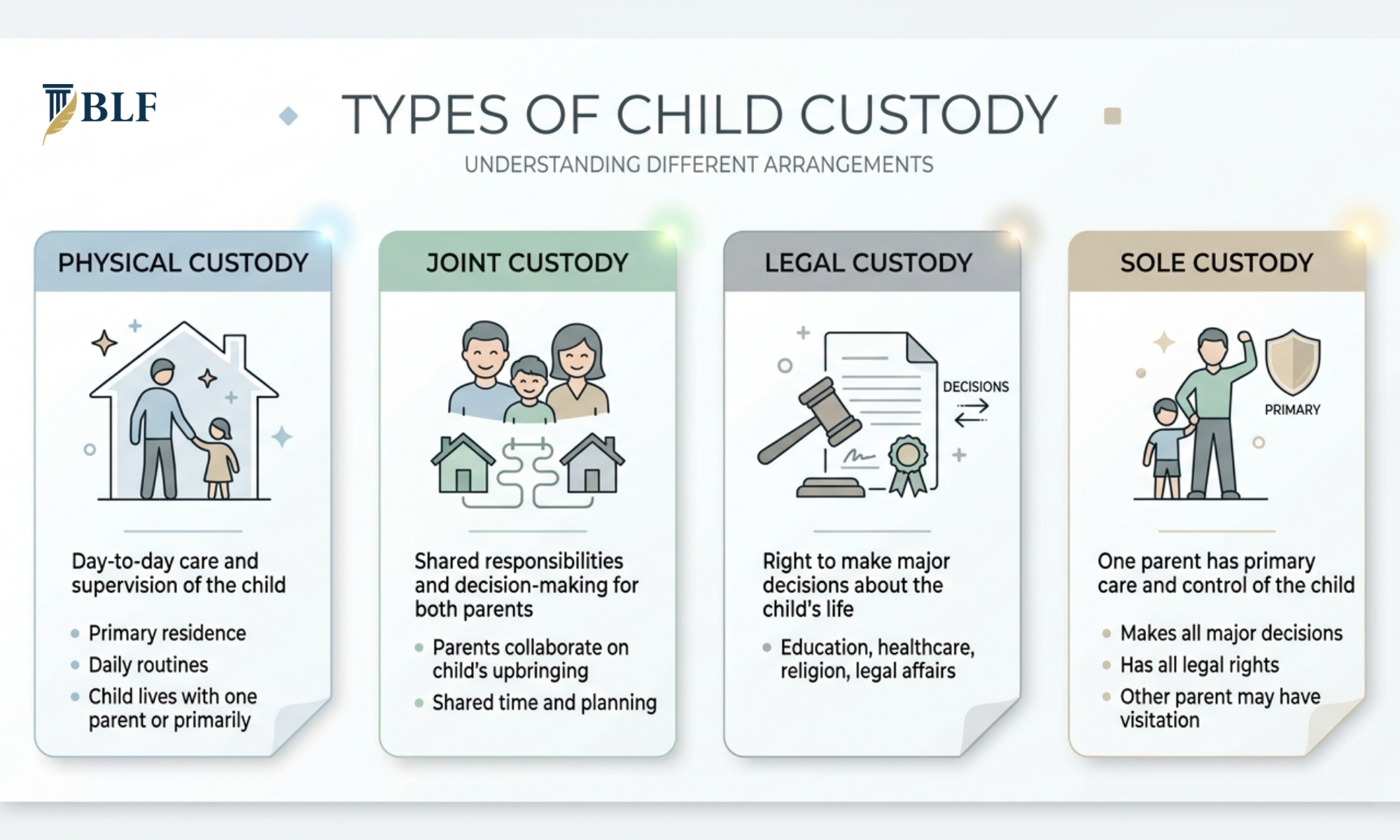
Types of Child Custody in India
Understanding the type of custody you are seeking helps you frame your case correctly from the start.
Physical Custody: The child lives primarily with one parent. The other parent typically receives visitation rights. Mothers most commonly seek and receive this in Indian courts.
Joint Custody: The child spends significant time with both parents – often alternating weeks or specific days. Indian courts are increasingly open to this arrangement when both parents are fit and cooperative.
Legal Custody: The right to make decisions about the child’s education, healthcare, and upbringing. This can be granted jointly even when physical custody goes to one parent.
Sole Custody: One parent receives both physical and legal custody. Granted when the other parent is deemed unfit – due to abuse, addiction, or neglect.
Most Indian courts today lean toward joint custody arrangements when both parents are capable, recognising that a child benefits from both relationships. However, primary physical custody still most often goes to the mother, particularly for younger children.

What Factors Do Indian Courts Consider?
Knowing what judges look for is your single most important advantage. Courts evaluate:
1. The Child’s Age and Preference For children under 5, custody almost always goes to the mother. For children above 9 –10 years, courts begin to consider the child’s own preference – though it is not binding.
2. Emotional Bonding: Who is the child’s primary caregiver? Who attends school events, doctor visits, and daily routines? Courts look closely at the depth of the parent-child relationship, not just biological connection.
3. Financial Stability You do not need to be wealthy – but you must demonstrate you can provide for your child’s basic needs: housing, schooling, healthcare, and daily care.
4. Moral Character and Lifestyle Courts assess whether either parent’s lifestyle could negatively impact the child. A history of domestic violence, substance abuse, or criminal record significantly weakens a parent’s custody claim.
5. Continuity and Stability Indian courts are reluctant to disrupt a child’s established routine. If your child is currently living with you, attending a particular school, and has a settled life – this works strongly in your favour.
6. Willingness to Co-Parent A parent who actively tries to alienate the child from the other parent is viewed negatively by courts. Demonstrating that you support a healthy relationship between your child and their father actually strengthens your case.

Practical Steps Mothers Should Take to Strengthen Their Custody Case
Winning custody is not just about legal arguments – it is about evidence, preparation, and consistency.
Document Your Role as Primary Caregiver: Collect school records, medical appointment history, activity registrations, and any communication showing your daily involvement in your child’s life. Courts respond to specifics, not general claims of being a “good mother.”
Maintain a Safe, Stable Home Environment: The court may conduct a home visit or request a welfare report. Your home should be age-appropriate, safe, and clearly set up for the child – their own space, their belongings, their comfort.
Keep a Detailed Diary: Record every instance of missed visitation by the father, any concerning behaviour, or threats. Date and timestamp every entry. This diary can become critical evidence if the case becomes contested.
Avoid Negative Behaviour During Proceedings: Do not speak negatively about the father in front of your child. Do not withhold the child from court-ordered visitation. Do not make social media posts about the case. Judges notice patterns of behaviour – and these actions consistently harm custody outcomes.
Obtain Character Witnesses: Teachers, paediatricians, neighbours, and family members who can testify to your relationship with your child and your caregiving ability carry real weight in custody hearings.
File for Interim Custody Immediately: If separation is recent or contentious, file for interim (temporary) custody right away. Courts are reluctant to disrupt living arrangements that have been in place during proceedings – so whoever has the child during the case often has an advantage when the final order is made.

Common Mistakes Mothers Make in Custody Cases
Assuming custody is automatic. Even with young children, you must actively build your case. Complacency is one of the most common reasons mothers lose custody disputes they should have won.
Using the child as leverage. Withholding the child from the father to gain negotiating power – on alimony, property, or anything else – is viewed extremely negatively by courts and can directly cost you custody.
Delaying legal action. Every week without a formal custody arrangement creates uncertainty. The longer the situation remains informal, the harder it becomes to establish your position legally.
Going without a lawyer. Child custody proceedings in India involve complex procedural and evidentiary requirements. A family lawyer does not just present your case – they anticipate the other side’s arguments and counter them.
If you’re looking for a family lawyer, choose someone who understands that your case is not just legal – it’s deeply personal.
With Bhatla Law Firm, you get more than representation. You get guidance, strategy, and a team that stands with you at every step – anticipating challenges, protecting your rights, and prioritizing your child’s well-being.
Contact Us today: +91-98990 04529
Frequently Asked Questions
Can a father get custody over the mother in India? Yes. If the court finds the mother unfit – due to substance abuse, instability, or demonstrated neglect – custody can be awarded to the father. Fitness, not gender, is the deciding standard.
Can the mother take the child out of India during custody proceedings? No. Taking a child out of the country without court permission during active custody proceedings can constitute contempt of court and seriously damage your case.
What if the father violates visitation orders? Document every violation with dates and details and report it to your lawyer immediately. Courts take violation of their orders seriously, and consistent violations by the father can be used to seek modification of the custody arrangement.
Can custody orders be changed after they are made? Yes. Either parent can apply for modification if there is a significant change in circumstances – relocation, remarriage, change in the child’s needs, or evidence of the other parent’s unfitness.
At what age can a child choose which parent to live with in India? There is no fixed age in law, but courts generally start giving weight to a child’s stated preference around 9–12 years. The child’s preference is considered, not automatically followed.

Protect Your Child’s Future with the Right Legal Support
Child custody cases are won on preparation, evidence, and legal strategy – not just emotion. Every document you collect, every step you take, and every decision you make during this period affects the outcome.
Bhatla Law Firm’s experienced family lawyers in Delhi have helped mothers across India secure custody of their children – from filing the initial petition to defending against aggressive contested claims. We build your case from the ground up, protect your rights at every hearing, and ensure your child’s welfare stays at the centre of every argument.
📞 Call or WhatsApp: +91-98990 04529 🌐 View on Google Maps
Speak to a lawyer today – confidential consultations available.
The bottom line: Indian law gives mothers strong grounds to win child custody – especially for young children. But the law alone does not win cases. Evidence, consistency, and the right legal guidance do.
Start building your case from day one.
Disclaimer: This article is for informational purposes only and does not constitute legal advice. Custody laws and outcomes vary by individual circumstance, religion, and jurisdiction. Please consult a qualified family lawyer before taking any legal action.

 +91 9899004529
